All use cases
Customers Paying Later · Predictive · about to happen
  1. 01How it is found
  2. 02What you see
  3. 03What you do next
  4. 04The money
  5. 05In both engines' views
  6. 06On from the start

8 days became 42.

Customers take longer to pay, so cash is tied up longer and costs money. Otiox compares how long paid invoices took in the last 60 days with the 120 before, and prices the delay on what is still open.
app.otiox.comFig. 00
Predictive · margin
Customers pay after 42 days instead of 8
Paid invoices · 60 days vs 120
SignalMeasuredValue
Days to pay before8
Last 60 days42
Cost of moneya year10 %
Cost of the delay: $75
What to do

Send reminders earlier and check which customers slowed down.

Customers pay on time again.

01The Challenge

Late payment is a margin problem, too.

For example: invoices used to be paid in 8 days; in the last 60 days, in 42. Every extra day the money is tied up costs you, at your cost of money.
  1. 01
    Payment terms drift
  2. 02
    Reminders go out late
  3. 03
    Cash is tied up longer
  4. 04
    The cost of carrying it is never counted
02SEE IT IN OTIOX

The same situation, in the product.

Real screens from the Otiox demo workspace, step by step.
  1. 01

    The forecast, with its cascade

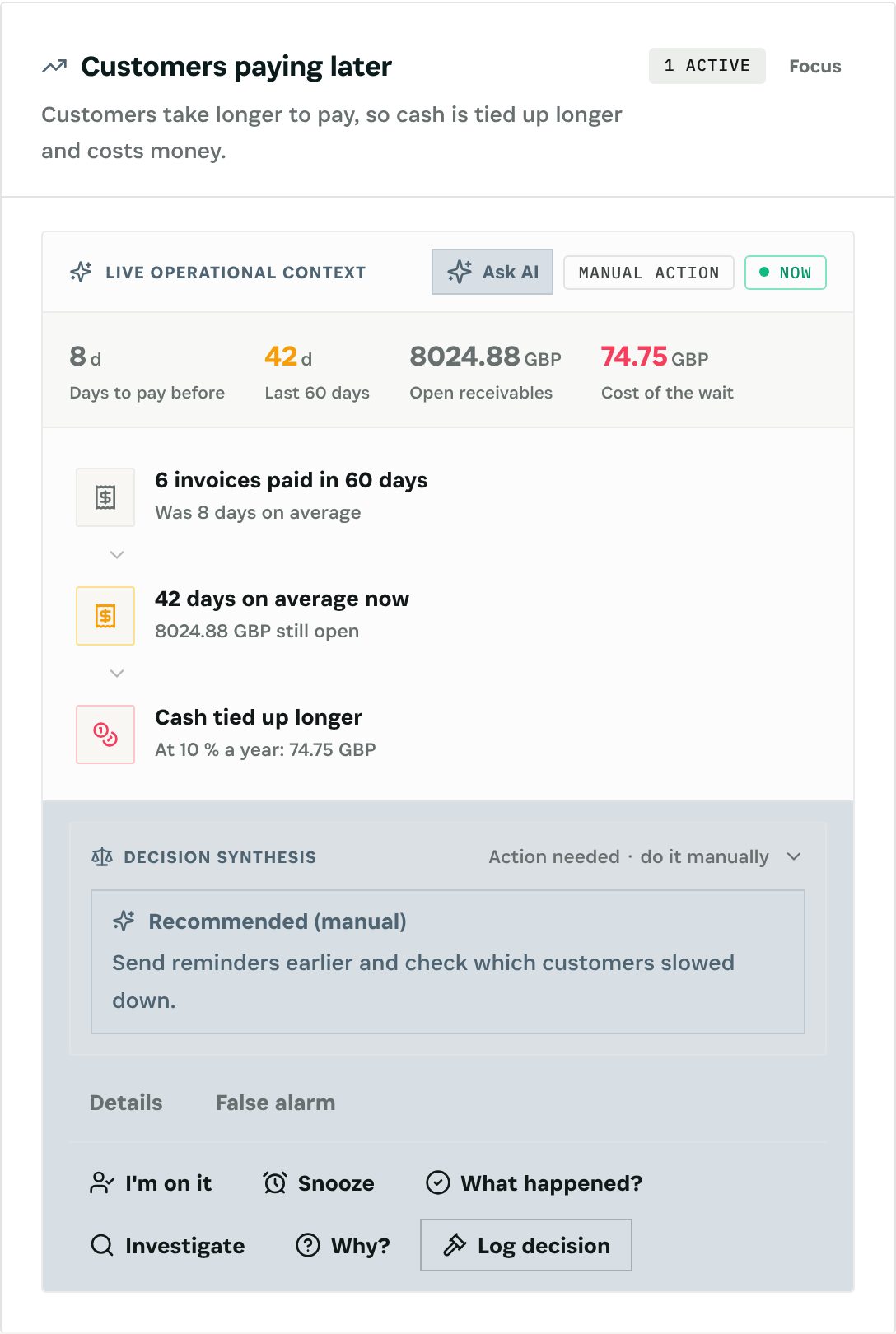
    The Predictive Engine's card shows the numbers behind the warning, the cascade from the record to the money and the recommended action. Send reminders earlier and check which customers slowed down.
    The forecast, with its cascade
  2. 02

    On, shadow or off

    The scenario's row on the Scenario switches page: how many findings are open, and its switch. It is on from the start; shadow keeps it counting without raising findings.

    On, shadow or off
03

How It Works

Purpose-built features that solve these exact problems.
01

How it is found

Days from issue to payment on paid customer invoices, last 60 days vs the 120 before, with at least 3 invoices in each window. It fires when customers pay at least 7 days later.
02

What you see

The Risk Inbox line "Customers pay after 42 days instead of 8", in the Predictive Engine.
03

What you do next

Send reminders earlier and check which customers slowed down.
04

The money

The cost of carrying open receivables for the extra days, at "Cost of money tied up (% a year)", 10 % by default.
05

In both engines' views

The finding appears in the Predictive Engine with its cascade from the record to the money, in the Risk Inbox and in the Loss Prevention Report.
06

On from the start

The scenario is on by default. Put it in shadow to keep it counting on the margin scenarios screen, with a six-month backtest, without raising findings, or switch it off.
04

What You'll Gain

Tangible improvements that impact your bottom line.
  1. 01
    Delay in money

    Not just days: what the delay costs.

  2. 02
    Early

    A trend, before cash gets tight.

  3. 03
    Counted with every other loss

    Margin findings feed the Loss Prevention Report next to the other engine findings.

  4. 04
    Nothing changes by itself

    No scenario changes a price, a discount or an order. You decide.

05

Real-World Scenarios

See how this works in practice.
Scenario 1

Slower payers

Invoices paid in 8 days now take 42.
Scenario 2

Warned

The finding shows the delay and its cost.
Scenario 3

Fixed

Reminders go out at the due date; two slow customers are called.
06

The Transformation

From chaos to clarity.
Before
  • Terms drift
  • Late reminders
  • Cash tied up
  • Cost never counted
After
  • Days to pay trended
  • 60 days vs 120 before
  • Cost of carrying shown
  • Reminders earlier
07

Frequently Asked Questions

Quick answers to common questions.
01How is the cost worked out?
Open receivables × your cost of money × the extra days ÷ 365.
02Can I set the cost of money?
Yes. "Cost of money tied up (% a year)" is a workspace setting, 10 % by default.
03Who sees the numbers?
Cost and margin figures are shown only to people with cost or accounting rights.
04Does Otiox change prices or orders?
No. No scenario changes a price, a discount or an order. It raises the finding and opens the record; the decision is yours.
05Can I put it in shadow or switch it off?
Yes. Every scenario is on from the start. Per scenario, you can put it in shadow (it keeps counting on the margin scenarios screen, with a six-month backtest, but raises nothing) or switch it off, on the margin card or the Scenario switches page. Thresholds are workspace settings.
06Which currency are the amounts in?
Your books currency, at the store's own rate. With no rate, the amount is left empty, never guessed. VAT is taken out before margins; test, cancelled, refunded, draft and abandoned orders are left out.
Customers Paying Later

Ready to transform your customers paying later?

See how Otiox can solve your specific challenges.