All use cases
Overhead per Unit Rising · Predictive · about to happen
  1. 01How it is found
  2. 02What you see
  3. 03What you do next
  4. 04The money
  5. 05In both engines' views
  6. 06On from the start

Same overhead, fewer units.

Production volume fell, so fixed overhead is spread over fewer units and each one costs more. Otiox compares overhead per unit produced in the last 60 days with the 120 before.
app.otiox.comFig. 00
Predictive · margin
Overhead per unit is rising
Completed orders · 60 days vs 120
SignalMeasuredValue
Overhead / unit before$5.00
Overhead / unit now$15.00
Production paceper daydown
Extra overhead a month: $200
What to do

Plan larger batches, review overhead rates, or price for the volume.

Unit cost is back in line with the price.

01The Challenge

The price was set at last year's volume.

For example: a product carried $5 of overhead per unit at 100 units a batch; at 20 a batch it carries $15. The price was set on the old volume.
  1. 01
    Overhead is fixed, volume is not
  2. 02
    Smaller batches cost more per unit
  3. 03
    Prices assume old volumes
  4. 04
    Margins thin without a cause on record
02SEE IT IN OTIOX

The same situation, in the product.

Real screens from the Otiox demo workspace, step by step.
  1. 01

    The forecast, with its cascade

    The Predictive Engine's card shows the numbers behind the warning, the cascade from the record to the money and the recommended action. Plan larger batches, review the overhead rates, or price for the smaller volume.
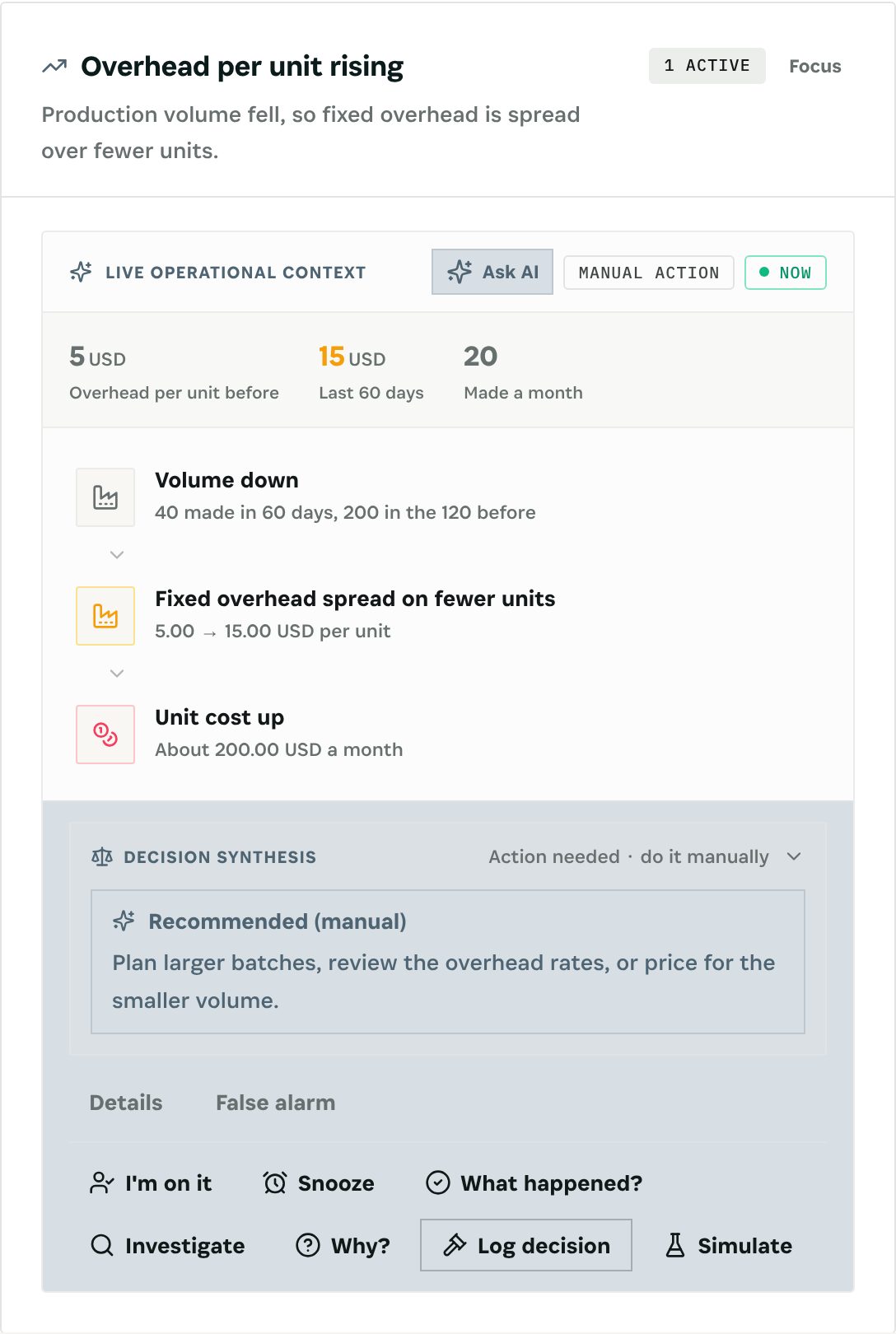
    The forecast, with its cascade
  2. 02

    On, shadow or off

    The scenario's row on the Scenario switches page: how many findings are open, and its switch. It is on from the start; shadow keeps it counting without raising findings.

    On, shadow or off
03

How It Works

Purpose-built features that solve these exact problems.
01

How it is found

Per product, overhead per unit produced on completed orders of the last 60 days vs the 120 before. It fires when it rises by more than 15 % while the daily production rate fell.
02

What you see

The Risk Inbox line "{product}: overhead per unit is rising" with an Open product button, in the Predictive Engine.
03

What you do next

Plan larger batches, review the overhead rates, or price for the smaller volume.
04

The money

The extra overhead per unit times the units produced, per month.
05

In both engines' views

The finding appears in the Predictive Engine with its cascade from the record to the money, in the Risk Inbox and in the Loss Prevention Report.
06

On from the start

The scenario is on by default. Put it in shadow to keep it counting on the margin scenarios screen, with a six-month backtest, without raising findings, or switch it off.
04

What You'll Gain

Tangible improvements that impact your bottom line.
  1. 01
    Volume in the unit cost

    See what lower volume does to each unit.

  2. 02
    A reason for the price

    Batch size or price, decided on numbers.

  3. 03
    Counted with every other loss

    Margin findings feed the Loss Prevention Report next to the other engine findings.

  4. 04
    Nothing changes by itself

    No scenario changes a price, a discount or an order. You decide.

05

Real-World Scenarios

See how this works in practice.
Scenario 1

Smaller batches

A product's batches drop from 100 to 20.
Scenario 2

Warned

The finding shows overhead per unit rising.
Scenario 3

Fixed

Orders are combined into larger batches.
06

The Transformation

From chaos to clarity.
Before
  • Overhead assumed constant
  • Small batches
  • Prices on old volume
  • Thin margins
After
  • Overhead per unit trended
  • Volume drop seen
  • Extra cost shown
  • Batches planned
07

Frequently Asked Questions

Quick answers to common questions.
01Where does overhead come from?
From the overhead recorded on completed production orders.
02Why does volume matter?
It only fires when overhead per unit rises while the daily production rate fell.
03Who sees the numbers?
Cost and margin figures are shown only to people with cost or accounting rights.
04Does Otiox change prices or orders?
No. No scenario changes a price, a discount or an order. It raises the finding and opens the record; the decision is yours.
05Can I put it in shadow or switch it off?
Yes. Every scenario is on from the start. Per scenario, you can put it in shadow (it keeps counting on the margin scenarios screen, with a six-month backtest, but raises nothing) or switch it off, on the margin card or the Scenario switches page. Thresholds are workspace settings.
06Which currency are the amounts in?
Your books currency, at the store's own rate. With no rate, the amount is left empty, never guessed. VAT is taken out before margins; test, cancelled, refunded, draft and abandoned orders are left out.
Overhead per Unit Rising

Ready to transform your overhead per unit rising?

See how Otiox can solve your specific challenges.