All use cases
Below Target Margin · Integrity · already happened
  1. 01How it is found
  2. 02What you see
  3. 03What you do next
  4. 04The money
  5. 05In both engines' views
  6. 06On from the start

Target 35 %. Making 22.

You set a target margin on the product. Its cost now leaves less. Otiox compares each product's cost, including a landed-cost override, with its own target margin and shows the gap.
app.otiox.comFig. 00
Integrity · margin
Under its target margin: 22 % (target 35 %)
Product · landed cost
SignalMeasuredValue
Selling price$50.00
Landed costoverride$39.00
Margintarget 35 %22 %
Gap to target: 13 points
What to do

Review the price or the cost (tariff, freight, supplier).

The product is back above its target.

01The Challenge

The target is on the product. Nobody checks it.

For example: a product's target margin is 35 %. It sells for $50 and its landed cost is now $39, a 22 % margin. The target was set once; the cost moved since.
  1. 01
    Targets are set once and forgotten
  2. 02
    Landed cost changes with tariff and freight
  3. 03
    Products below target hide in averages
  4. 04
    Negative margins go unnoticed
02SEE IT IN OTIOX

The same situation, in the product.

Real screens from the Otiox demo workspace, step by step.
  1. 01

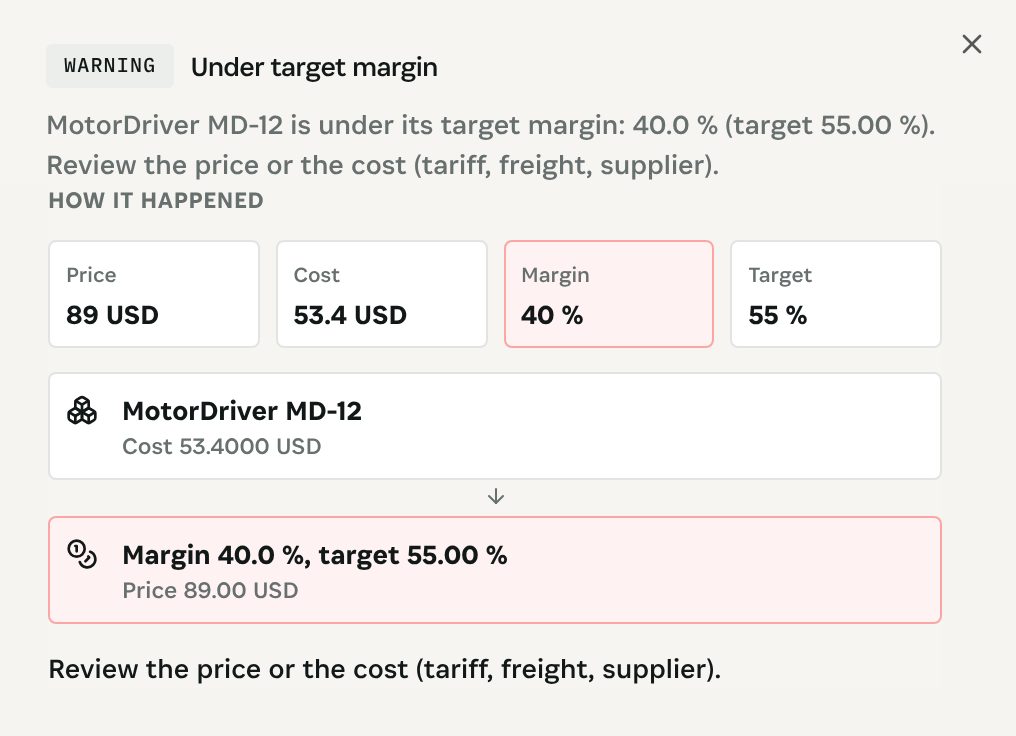
    The finding, and how it happened

    The Integrity Engine's finding names the record and what to do, and its cascade shows how it reached the money. Review the price or the cost: tariff, freight, supplier.
    The finding, and how it happened
  2. 02

    On, shadow or off

    The scenario's row on the Scenario switches page: how many findings are open, and its switch. It is on from the start; shadow keeps it counting without raising findings.

    On, shadow or off
03

How It Works

Purpose-built features that solve these exact problems.
01

How it is found

Products with their own target margin (set in tariff settings) whose cost, the landed-cost override or else the product's unit cost, leaves a margin under that target. High when the margin is negative.
02

What you see

The Risk Inbox line "{product} is under its target margin: 22 % (target 35 %)" with an Open product button, in the Integrity Engine.
03

What you do next

Review the price or the cost: tariff, freight, supplier.
04

The money

No amount is shown: it is a state, not a loss on a record. The finding shows the gap in points.
05

In both engines' views

The finding appears in the Integrity Engine with its cascade from the record to the money, in the Risk Inbox and in the Loss Prevention Report.
06

On from the start

The scenario is on by default. Put it in shadow to keep it counting on the margin scenarios screen, with a six-month backtest, without raising findings, or switch it off.
04

What You'll Gain

Tangible improvements that impact your bottom line.
  1. 01
    Targets that are checked

    Every product with a target is compared with it.

  2. 02
    Landed cost included

    The landed-cost override counts when it is set.

  3. 03
    Counted with every other loss

    Margin findings feed the Loss Prevention Report next to the other engine findings.

  4. 04
    Nothing changes by itself

    No scenario changes a price, a discount or an order. You decide.

05

Real-World Scenarios

See how this works in practice.
Scenario 1

Below target

A product with a 35 % target now makes 22 %.
Scenario 2

Flagged

The finding shows the margin today and the target.
Scenario 3

Fixed

The price is raised; the margin is back above target.
06

The Transformation

From chaos to clarity.
Before
  • Targets set and forgotten
  • Cost moved since
  • Gaps hidden in averages
  • Negative margins unseen
After
  • Each product vs its target
  • Gap in points
  • Negative margins flagged high
  • Price or cost reviewed
07

Frequently Asked Questions

Quick answers to common questions.
01How is this different from Margin Erosion?
Margin Erosion is the Predictive Engine's forecast with the price that restores the target. This finding is the product's own target-margin rule, checked as it stands today.
02Where is the target set?
On the product, in its tariff settings.
03Who sees the numbers?
Cost and margin figures are shown only to people with cost or accounting rights.
04Does Otiox change prices or orders?
No. No scenario changes a price, a discount or an order. It raises the finding and opens the record; the decision is yours.
05Can I put it in shadow or switch it off?
Yes. Every scenario is on from the start. Per scenario, you can put it in shadow (it keeps counting on the margin scenarios screen, with a six-month backtest, but raises nothing) or switch it off, on the margin card or the Scenario switches page. Thresholds are workspace settings.
06Which currency are the amounts in?
Your books currency, at the store's own rate. With no rate, the amount is left empty, never guessed. VAT is taken out before margins; test, cancelled, refunded, draft and abandoned orders are left out.
Below Target Margin

Ready to transform your below target margin?

See how Otiox can solve your specific challenges.