Order Promise

A customer wants five thousand units by month-end. Know what you can promise before you say yes.

Otiox checks a large order against the materials you have, what the build will cost and who is available to run it — and warns you when committed demand can no longer be promised — so the answer you give sales is based on your operation, not on optimism.
app.otiox.comFig. 00
Can we promise?
5,000 × SmartSensor S100 Black
Falcon Robotics · framework order · by Oct 30
ComponentRequiredAvailable
PCB Mainboard Rev35,000 pcs168 pcs
Li-Ion Battery 3000mAh5,000 pcs220 pcs
Aluminum 6061 Sheet250 kg450 kg
Short 4,832 PCBs and 4,780 battery cells
Material cost
$139,700
$27.94 per unit
Operations staffed
0 / 5
SMT, reflow, assembly, QC, pack
The answer

Not by Oct 30 from stock. Order PCBs and cells first, staff the five operations, then confirm the date.

01The Challenge

“Yes” is easy to say. It is expensive to break.

Falcon Robotics asks for 5,000 SmartSensors by the end of October. Sales wants an answer today. Whether the plant can deliver depends on components, on cost and on people — and that information usually lives in three different places.
  1. 01
    Sales commits a date before anyone has checked the components
  2. 02
    The component shortage shows up when the build is already scheduled
  3. 03
    The real cost per unit is known only after the order ships
  4. 04
    Nobody notices that a promise is slipping until the customer does
02SEE IT IN OTIOX

The same situation, in the product.

Real screens from the Otiox demo workspace, step by step.
  1. 01

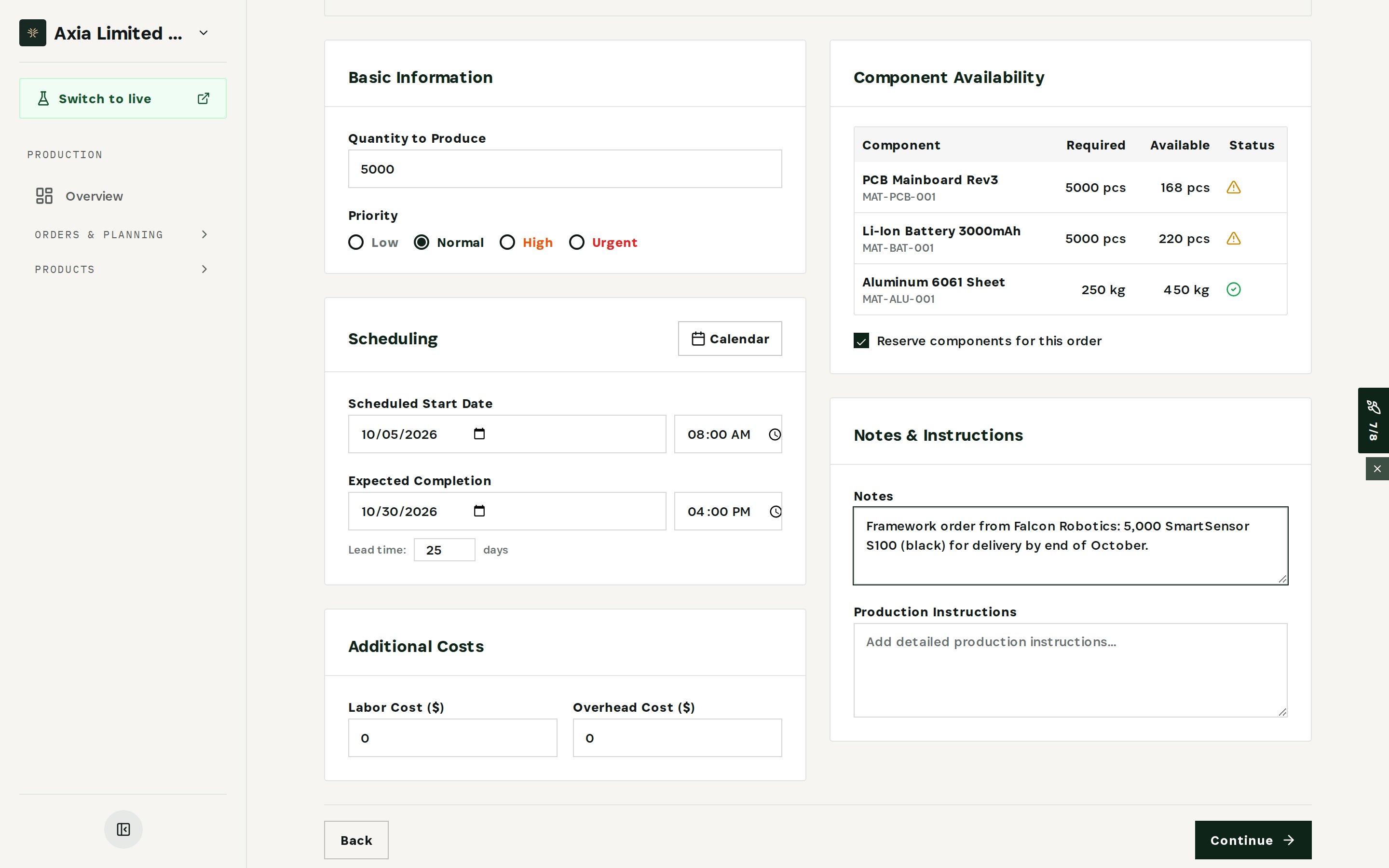
    Enter the quantity, check the components

    5,000 SmartSensors need 5,000 PCBs and 5,000 battery cells. There are 168 and 220 — the shortage is visible immediately.
    Enter the quantity, check the components
  2. 02

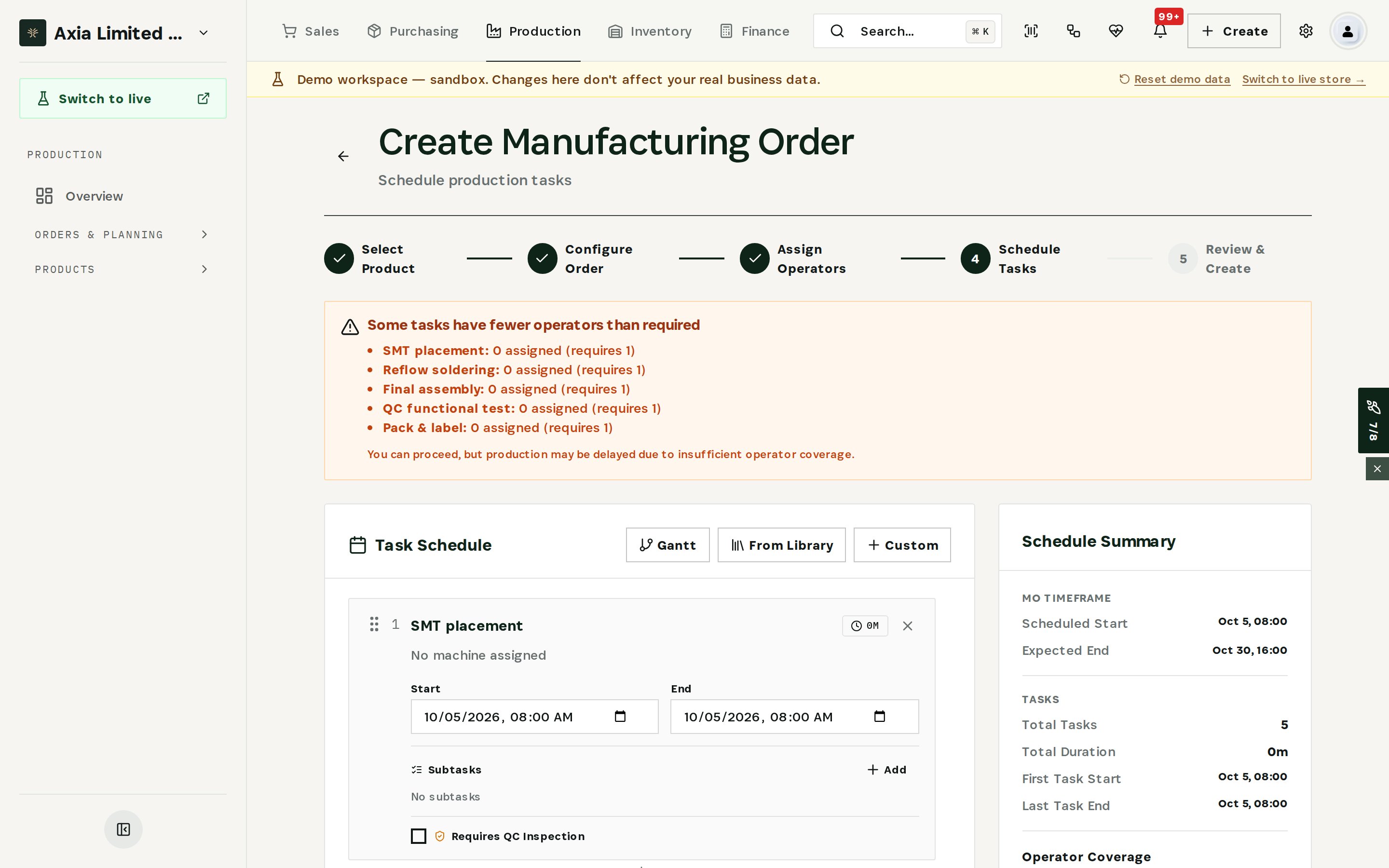
    Load operations from the routing

    Every step of the build — SMT placement to pack & label — is loaded from the routing, with the operators each step needs.
    Load operations from the routing
  3. 03

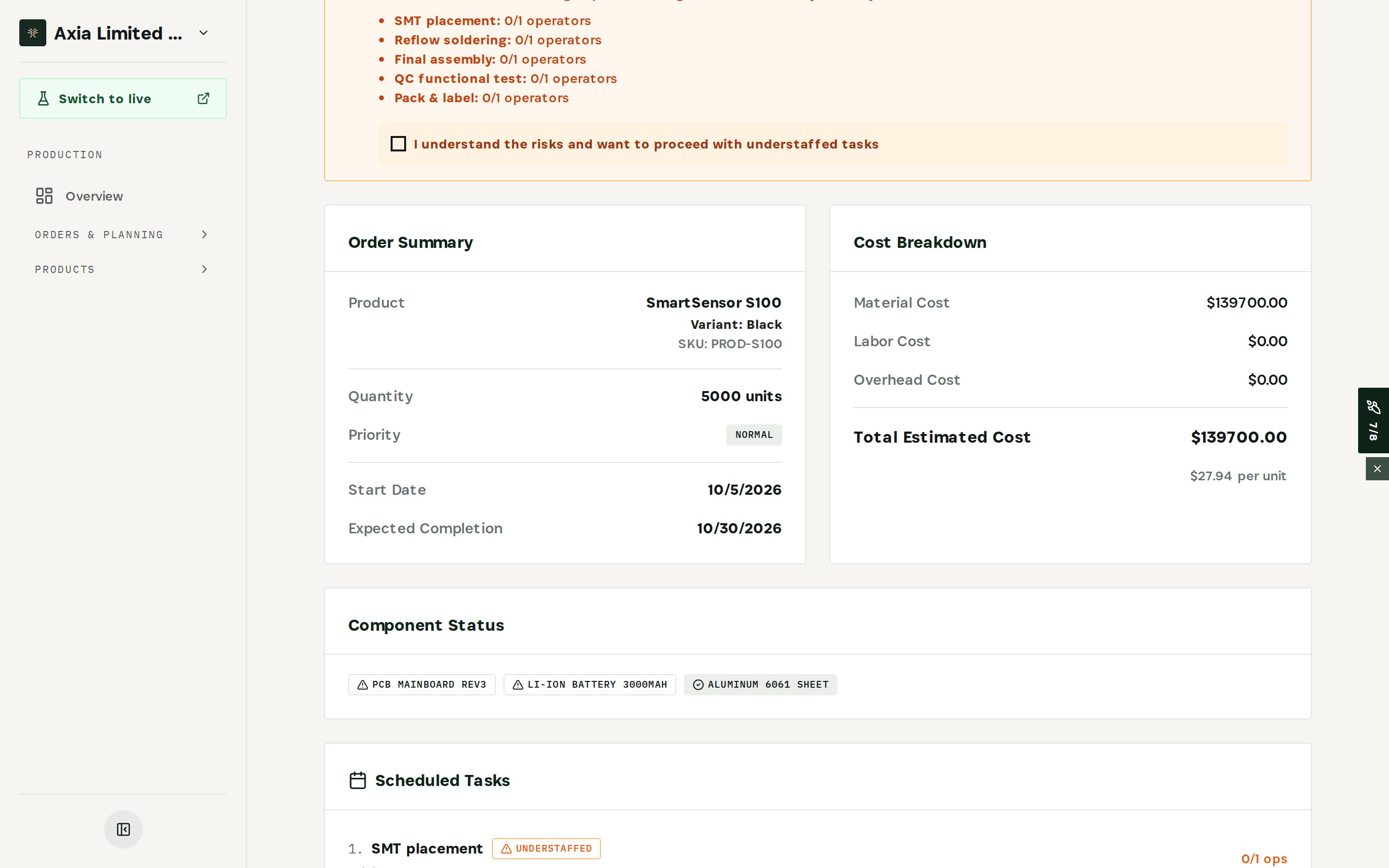
    Review cost and coverage

    $139,700 in materials, $27.94 per unit, and five operations that are still understaffed. Save as a draft while you agree on the date.
    Review cost and coverage
  4. 04

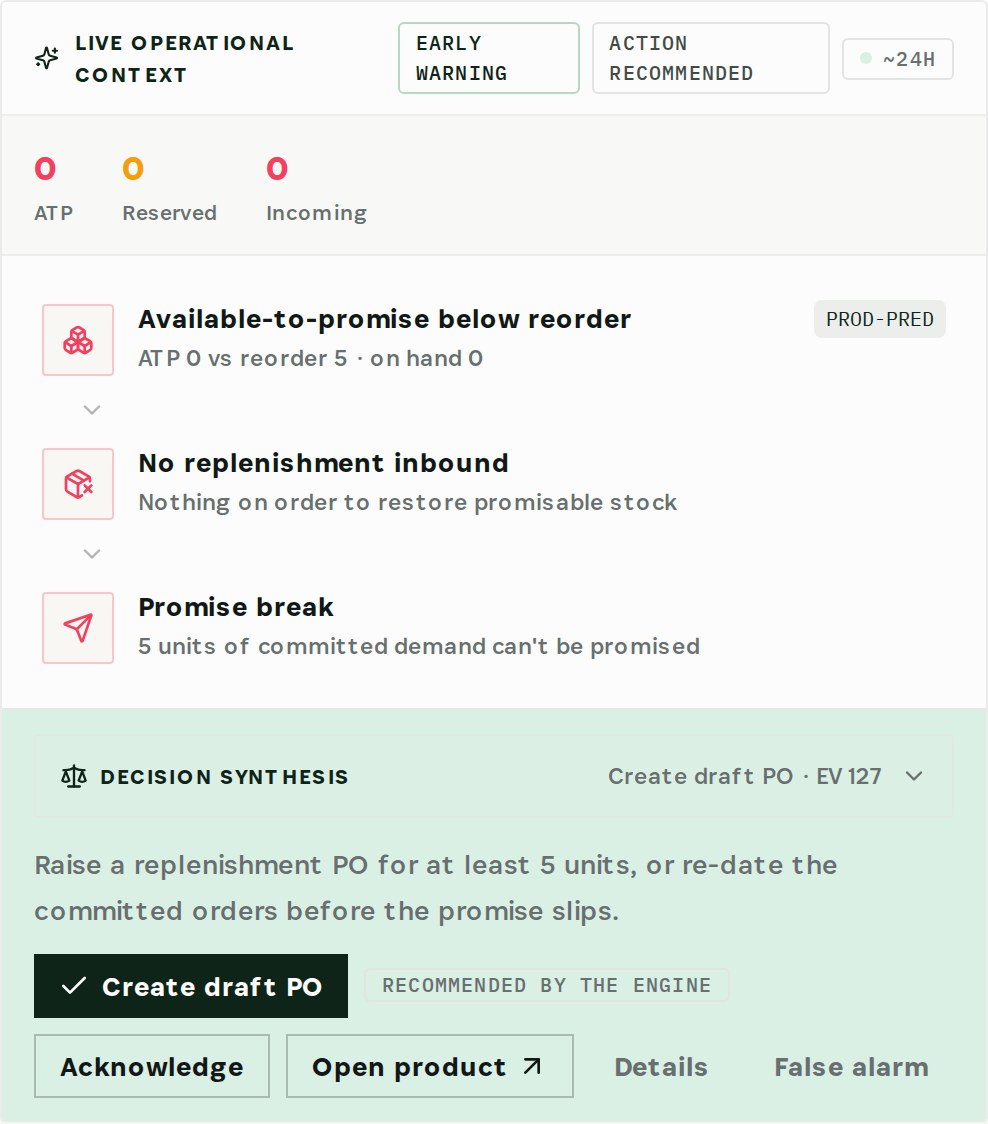
    Watch for promises about to break

    The Predictive Engine flags products whose available-to-promise stock can no longer cover committed orders, and recommends the next step.
    Watch for promises about to break
03

How It Works

Purpose-built features that solve these exact problems.
01

Component availability check

Enter the quantity and the manufacturing order shows every component with the required and available amount, flagging each shortage.
02

Routing and crew coverage

Operations load from the product's routing or are added by hand, and every task shows whether enough qualified operators are assigned.
03

Cost before commitment

The review shows the material cost of the whole order and the cost per unit, before anything is released to the floor.
04

Draft orders

Save the order as a draft to hold the plan without reserving stock while purchasing and sales agree on the date.
05

Promise-break warnings

The Predictive Engine watches available-to-promise stock and warns when committed demand can no longer be covered, with a recommended action.
04

What You'll Gain

Tangible improvements that impact your bottom line.
  1. 01
    Answer with evidence

    The gap between what the order needs and what you have is on one screen, so the answer to sales is a fact.

  2. 02
    Know the margin up front

    Material cost per unit is known before you agree on a price.

  3. 03
    Plan the people, too

    Understaffed operations are flagged at planning time, not on the first day of the build.

  4. 04
    Catch promises before they slip

    When available-to-promise stock can no longer cover committed orders, you hear it from Otiox, not from the customer.

05

Real-World Scenarios

See how this works in practice.
Scenario 1

Five thousand units, two components short

The order needs 5,000 PCBs and 5,000 battery cells. There are 168 and 220 in stock; aluminium is covered. The shortage is the purchasing plan.
Scenario 2

The real cost per unit

The review prices the order at $139,700 in materials — the floor for any price you quote Falcon Robotics.
Scenario 3

A promise that is already slipping

On another product, available-to-promise has dropped to zero with nothing inbound. The engine recommends a replenishment PO before committed orders are missed.
06

The Transformation

From chaos to clarity.
Before
  • Dates committed on gut feeling
  • Shortages found when the build starts
  • Cost per unit known after shipping
  • Slipped promises discovered by the customer
After
  • Every component checked against the quantity
  • Shortages visible before the order is confirmed
  • Material cost per unit known up front
  • Promise breaks flagged with a recommended action
07

Frequently Asked Questions

Quick answers to common questions.
01Does creating the order reserve stock?
Yes, when you reserve and schedule it or start production — the components are reserved as the order is created. To evaluate a request without reserving anything, save the order as a draft.
02Does Otiox calculate a delivery date automatically?
Otiox shows the component gap, cost and crew coverage for the date you plan. Choosing the date you promise stays with your team.
03Where do the operations come from?
From the product's routing, or added to the order by hand — while you create it or later. Each operation lists its required skills and the operators assigned to it.
04What triggers a promise-break warning?
The Predictive Engine compares available-to-promise stock and inbound supply with committed demand, and raises an early warning when the demand can't be covered.
Order Promise

Ready to transform your order promise?

See how Otiox can solve your specific challenges.