Supplier Slip Impact

A supplier slips a week. What breaks?

One late purchase order rarely stays one problem. Otiox follows the dependency chain — purchase order, the manufacturing orders that need its material, the customer orders those feed — and shows what is late now, what becomes late if it slips further, and which customers are affected. A what-if simulation tests the delay before it happens.
app.otiox.comFig. 00
Command · impact
One late purchase order
Purchase order → builds → customer orders
LinkRecordState
Purchase orderPCB orderLate now
BuildManufacturing orderWaiting for material
CustomerSales orderAt risk
Customer orders affected
Simulate

Test a further slip before it happens.

Customers told days ahead, not on the day.

01The Challenge

Everyone sees the late PO. Nobody sees what hangs on it.

Purchasing knows the supplier is late. Production finds out when the material isn't there. Sales finds out when the customer calls. Each team sees one link of the chain; nobody sees the chain.
  1. 01
    Dependencies live in people's heads
  2. 02
    Impact discovered one team at a time
  3. 03
    No way to test a delay in advance
  4. 04
    Customers told last
02SEE IT IN OTIOX

The same situation, in the product.

Real screens from the Otiox demo workspace, step by step.
  1. 01

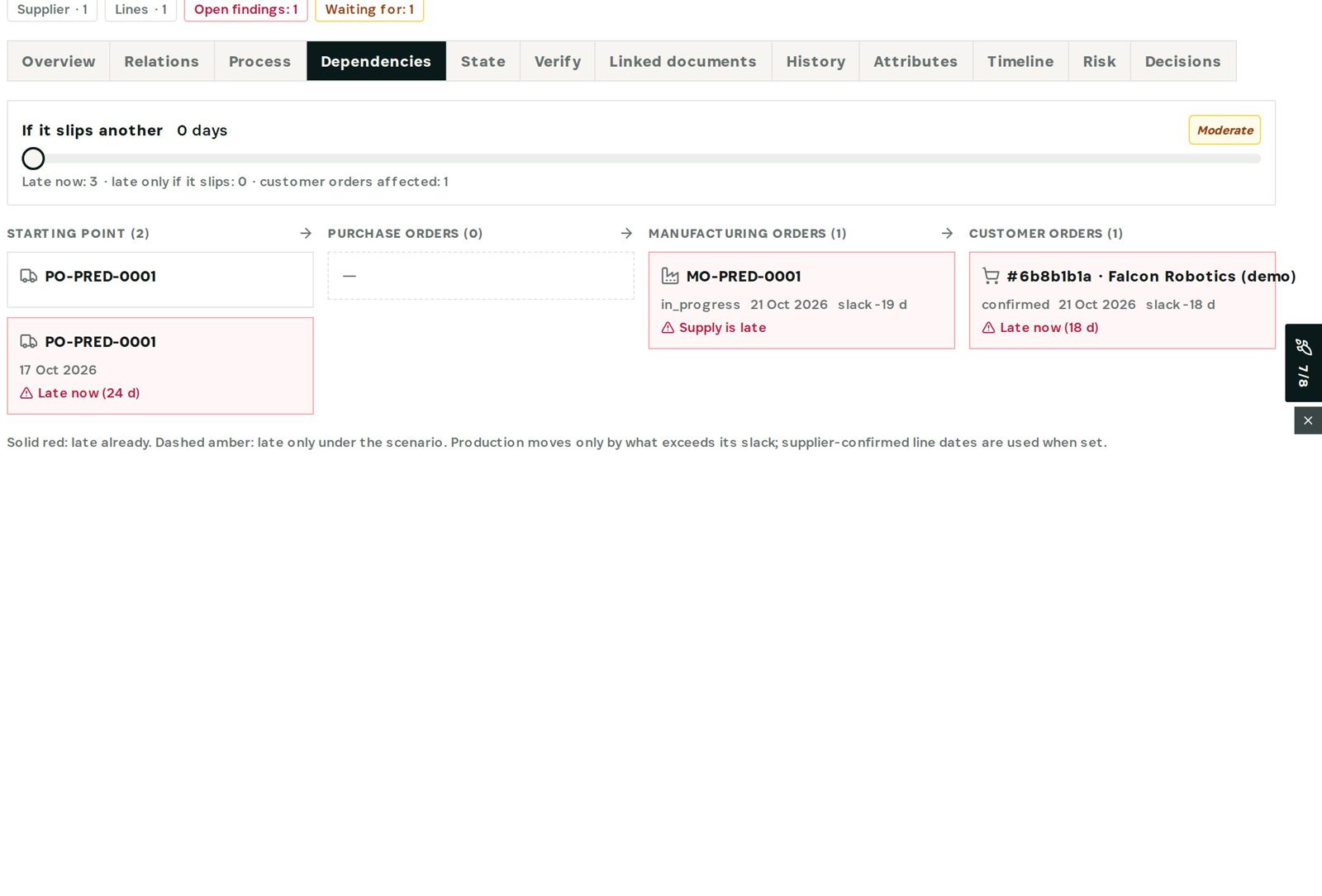
    Impact on the purchase order

    Late now, late only if it slips further, and the customer orders affected.
    Impact on the purchase order
  2. 02

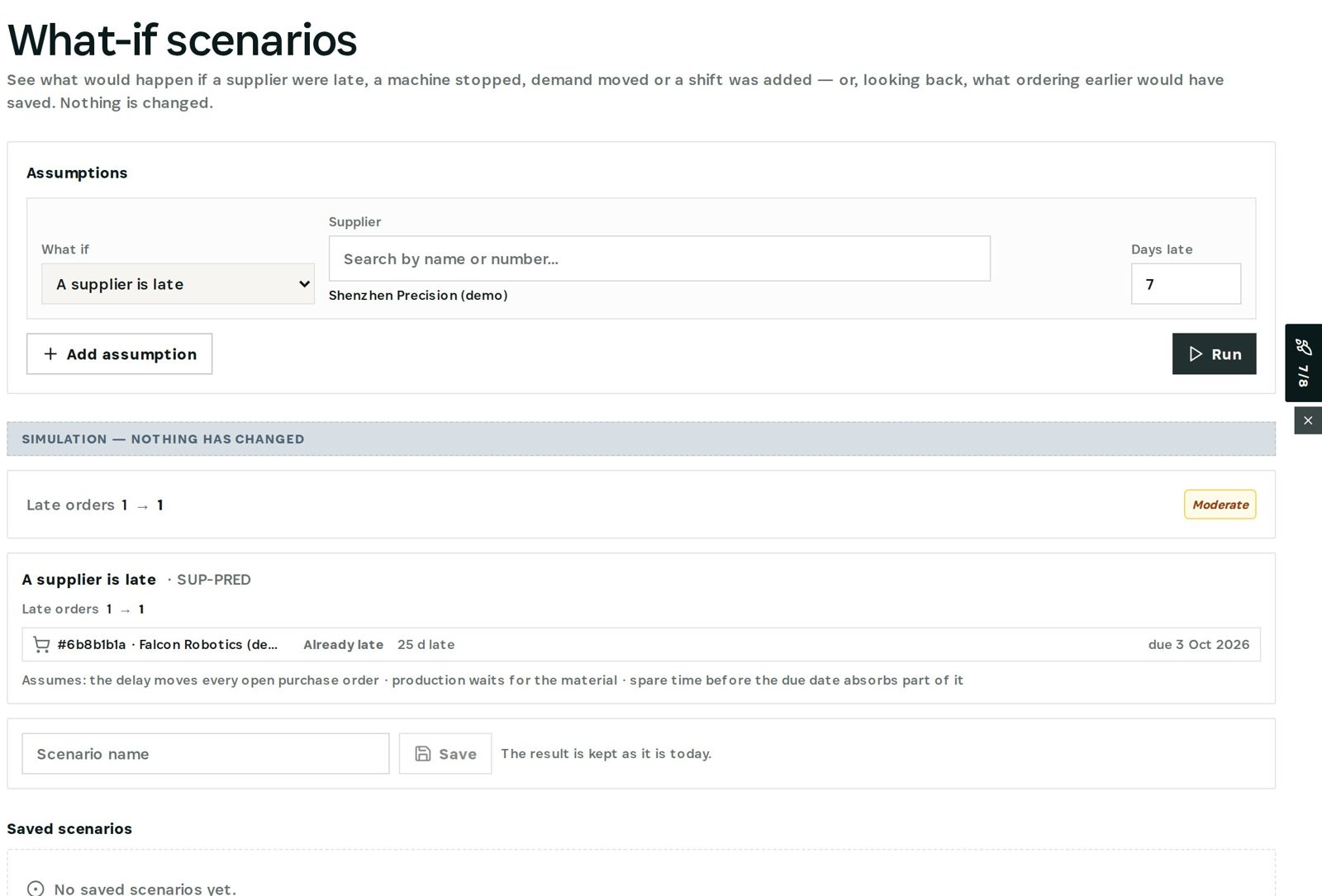
    What-if simulation

    The supplier late a week: which orders turn late, and by how much.
    What-if simulation
03

How It Works

Purpose-built features that solve these exact problems.
01

Impact tab

On any purchase order: what is late now, what becomes late if it slips N more days, and the customer orders affected.
02

Dependency chain

Purchase order → manufacturing orders → customer orders, with links to each.
03

What-if scenarios

Simulate a supplier or PO being late, a machine stopping or demand changing — nothing is changed.
04

Explorer

Any record and everything connected to it, two steps out.
04

What You'll Gain

Tangible improvements that impact your bottom line.
  1. 01
    One view of the chain

    Purchasing, production and sales see the same picture.

  2. 02
    Days of warning

    Know which customers are exposed before they are late.

  3. 03
    Test before you commit

    Simulate the delay, then decide.

  4. 04
    Nothing changed

    Scenarios never touch your records.

05

Real-World Scenarios

See how this works in practice.
Scenario 1

Late material, late build

A PCB order three weeks late holds up the build that serves a customer order.
Scenario 2

A week more

The slider shows what else turns late if it slips another seven days.
Scenario 3

Supplier-wide delay

Simulate every open order from one supplier arriving a week late.
06

The Transformation

From chaos to clarity.
Before
  • Each team sees one link
  • Impact found when it hurts
  • Delays tested in production
  • Customers told last
After
  • Whole chain in one view
  • Affected customers named
  • Delay simulated first
  • Customers told early
07

Frequently Asked Questions

Quick answers to common questions.
01Where does the chain come from?
From the records themselves: purchase order lines, bills of materials, manufacturing order components and the customer orders they serve.
02Does a scenario change anything?
No. It simulates; saved scenarios keep their result.
03What can I simulate?
A supplier or purchase order late, a machine stopping, demand changing, an extra shift — or, looking back, ordering earlier.
04Is spare time considered?
Yes — slack before a due date absorbs part of the delay.
Supplier Slip Impact

Ready to transform your supplier slip impact?

See how Otiox can solve your specific challenges.