Supply Shock Response

See a supply shock land before it does

Tariffs jump, a supplier slips, a delivery date quietly becomes impossible. Otiox models the shock across every product, order and margin — and tells you which response is worth paying for.
app.otiox.comFig. 00
Tariff scenario
China 35% supply shock
3
Below margin target
+$49
Additional duty
−18.5%
Avg margin change
0
Unprofitable
Cross-module cascade
Supplier shipment delayed
Shenzhen Precision · 5 days late
Purchase order behindPO-0001
200 units pending
Build short on materialMO-0001
120 PCBs short
Customer order at riskSO-0001
Due 3 Oct · P(slip) 57%
Decision synthesis

Substitute the component. Expediting costs 150 and cuts the expected loss by only ~103.

01The Challenge

Shocks don't arrive one at a time

A duty change reprices half your bill of materials overnight. A supplier runs five days late, and a customer order three steps downstream quietly becomes impossible. By the time the spreadsheets are updated, the window to act has closed.
  1. 01
    Tariff changes are modelled in spreadsheets that are out of date the day they are built
  2. 02
    Nobody can say which customer orders a late purchase order will actually break
  3. 03
    Expediting is the reflex — even when it costs more than the loss it prevents
  4. 04
    Margin damage shows up at month-end, when the price can no longer be changed
02SEE IT IN OTIOX

The same situation, in the product.

Real screens from the Otiox demo workspace, step by step.
  1. 01

    Model the shock

    Create a tariff scenario and override the duty on the affected products. The projected impact updates as you go.
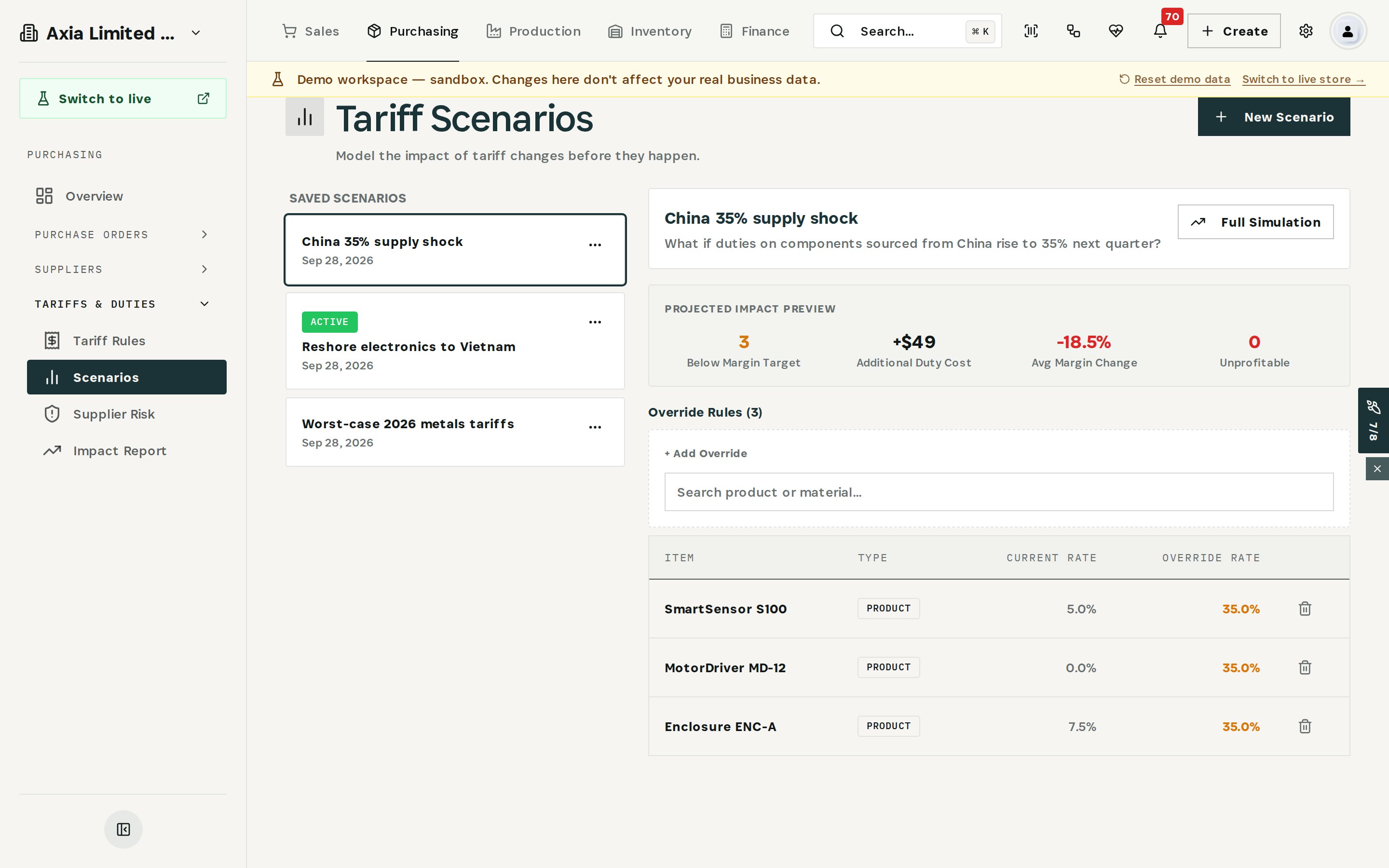
    Model the shock
  2. 02

    Simulate across the catalogue

    Full simulation shows the products below margin target, the additional duty cost and the price rise that restores each margin.
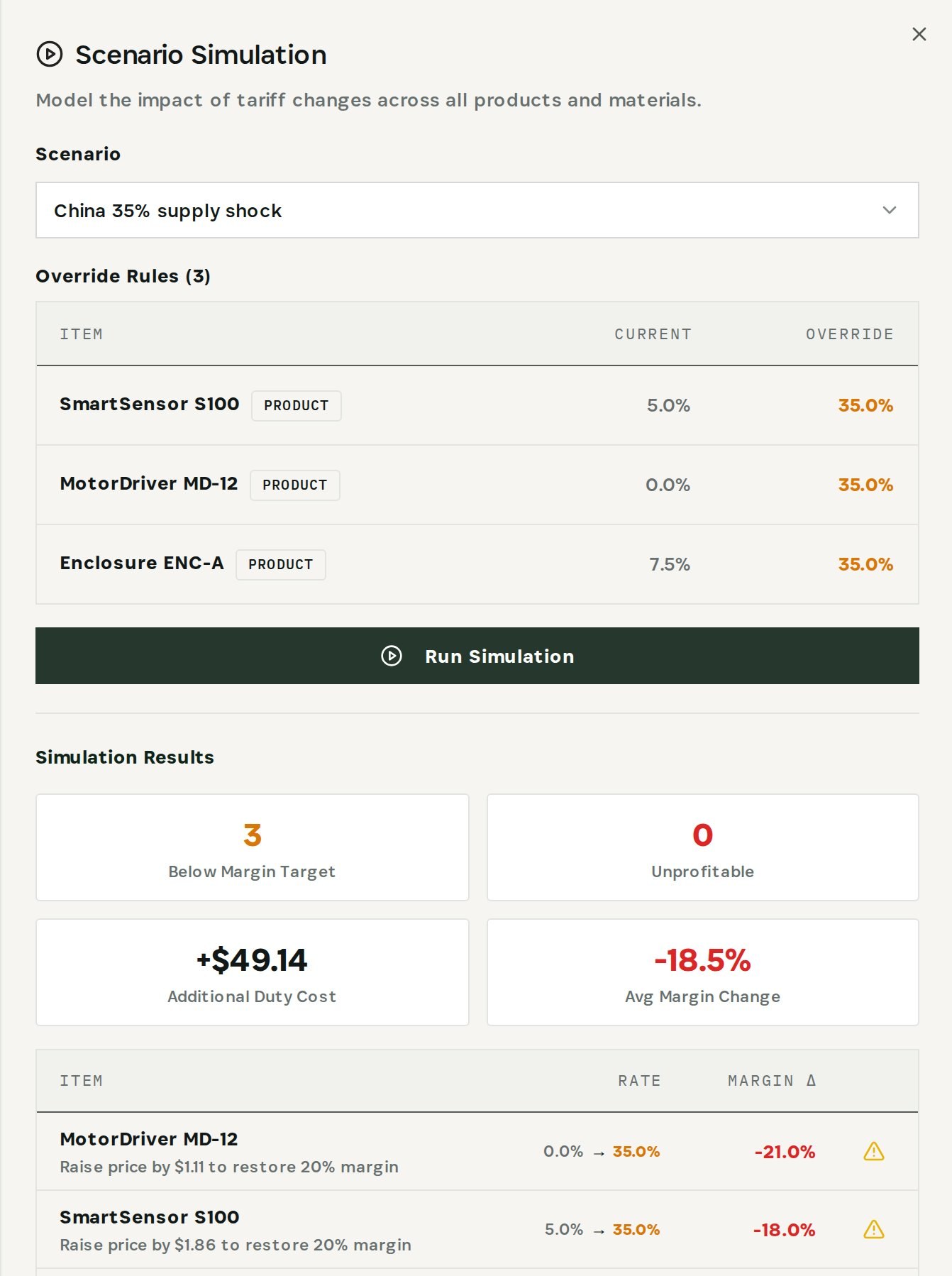
    Simulate across the catalogue
  3. 03

    See every forecast in one place

    The Predictive Engine ranks what will go wrong, when and why — across inventory, purchasing, production and finance.
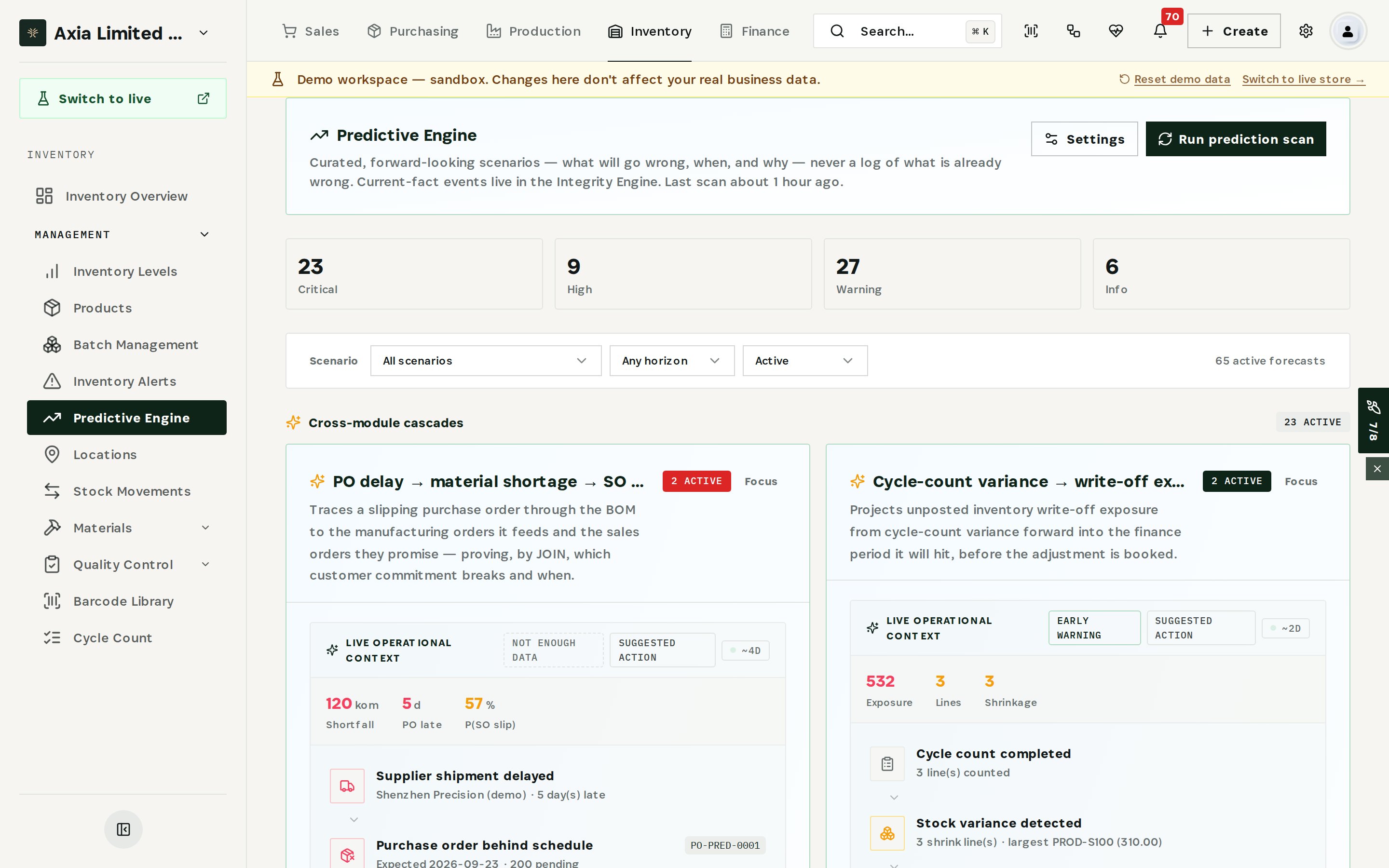
    See every forecast in one place
  4. 04

    Follow the cascade, then decide

    A five-day supplier delay traced to the manufacturing order and customer order it threatens, with the cheapest effective response recommended.
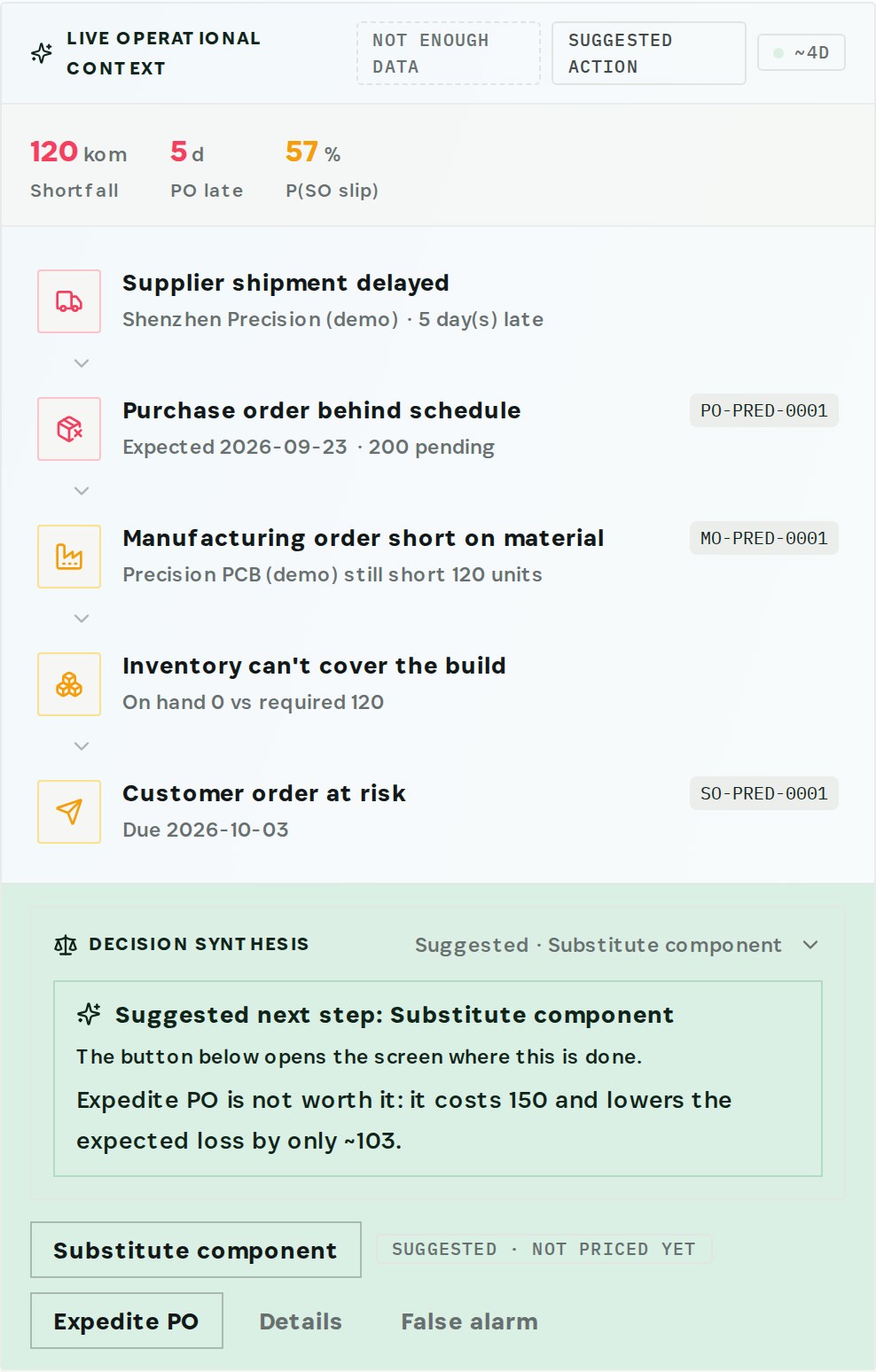
    Follow the cascade, then decide
03

How It Works

Purpose-built features that solve these exact problems.
01

Tariff scenarios

Model a duty change before it happens. Override the rate per product or material and watch the projected impact on landed cost and margin update instantly.
02

Full simulation

Run a scenario across the whole catalogue: products pushed below margin target, additional duty cost and average margin change — with the price move that restores each margin.
03

Cross-module cascades

The Predictive Engine follows a slipping purchase order through the bill of materials to the manufacturing orders it feeds and the customer orders they promise.
04

Decision synthesis

Every cascade ends in a recommendation — substitute, expedite or accept — weighed against what each option actually costs.
05

Impact report

Base cost, tariff rate, landed cost and margin for every item in one table, with the items in breach flagged for action.
04

What You'll Gain

Tangible improvements that impact your bottom line.
  1. 01
    Decide in days, not quarters

    Scenario results are ready the moment a rate changes — while there is still time to reprice, re-source or re-plan.

  2. 02
    Spend only where it pays

    Decision synthesis shows when expediting is worth it and when it isn't, so recovery budget goes where it reduces real loss.

  3. 03
    Protect customer commitments

    Know which orders are at risk, by how much and when — before the customer finds out.

  4. 04
    Defend the margin

    Every product pushed below target comes with the exact price change that restores it.

05

Real-World Scenarios

See how this works in practice.
Scenario 1

A thirty-five percent duty on Chinese components

Create a scenario, override the duty on the affected products and run a full simulation. Three products fall below margin target, and Otiox shows the price rise that restores each one.
Scenario 2

A supplier ships five days late

The Predictive Engine links the late purchase order to the manufacturing order it feeds and the customer order that depends on it, then recommends substituting the component rather than paying to expedite.
Scenario 3

Comparing a new supply route

Save a second scenario for the alternative route — for example, re-sourcing to Vietnam — and compare it with the first before anything is signed.
06

The Transformation

From chaos to clarity.
Before
  • Tariff impact modelled in spreadsheets
  • Late purchase orders discovered when production stops
  • Expediting by reflex
  • Margin damage found at month-end
After
  • Scenarios simulated across the whole catalogue
  • Supplier-to-customer cascade traced automatically
  • Every option priced before you act
  • The price move that restores margin, per product
07

Frequently Asked Questions

Quick answers to common questions.
01Where do the tariff rates come from?
You maintain tariff rules per product, material or supplier in Otiox. Scenarios override those rates without changing them, so you can model a change safely.
02Does a scenario change my live data?
No. A scenario is a simulation. Tariff rules, costs and prices change only when your team decides to change them.
03What does the Predictive Engine need to trace a cascade?
Purchase orders with expected dates, bills of materials, manufacturing orders and sales orders. Once those live in Otiox, the links between them are built automatically.
04Will Otiox act on a recommendation by itself?
No. A recommendation opens the screen where the change is made, and automated actions can stay disabled until your team signs off the model.
Supply Shock Response

Ready to transform your supply shock response?

See how Otiox can solve your specific challenges.